PULSAR
An experimental game engine and editor built entirely in Rust — stable, extensible, open source.
Core Technology
Built for Performance
A technology stack chosen deliberately — not for hype, but because each piece makes games better.

Rust All the Way Down
The editor, the renderer, the plugins — everything is Rust. Projects are standard Cargo workspaces. No custom scripting language, no VM overhead, just native performance with compile-time safety.

Zero-Copy GPU Rendering
A three-layer compositor shares textures directly in GPU memory — Bevy renders the 3D viewport, GPUI renders the editor UI, and D3D11 composites them with no CPU copies. Smooth 60 FPS even with a complex scene.

Rapier3D Physics
Rapier powers Pulsar's physics simulation — a pure-Rust engine running on a background thread for consistent physics ticks. Rigid body dynamics, collision detection, and constraints with deterministic results.
Engine Deep Dive
Every Tool You Need
Pulsar ships with a full editor suite — not just a runtime. Here's what's inside.
World Building
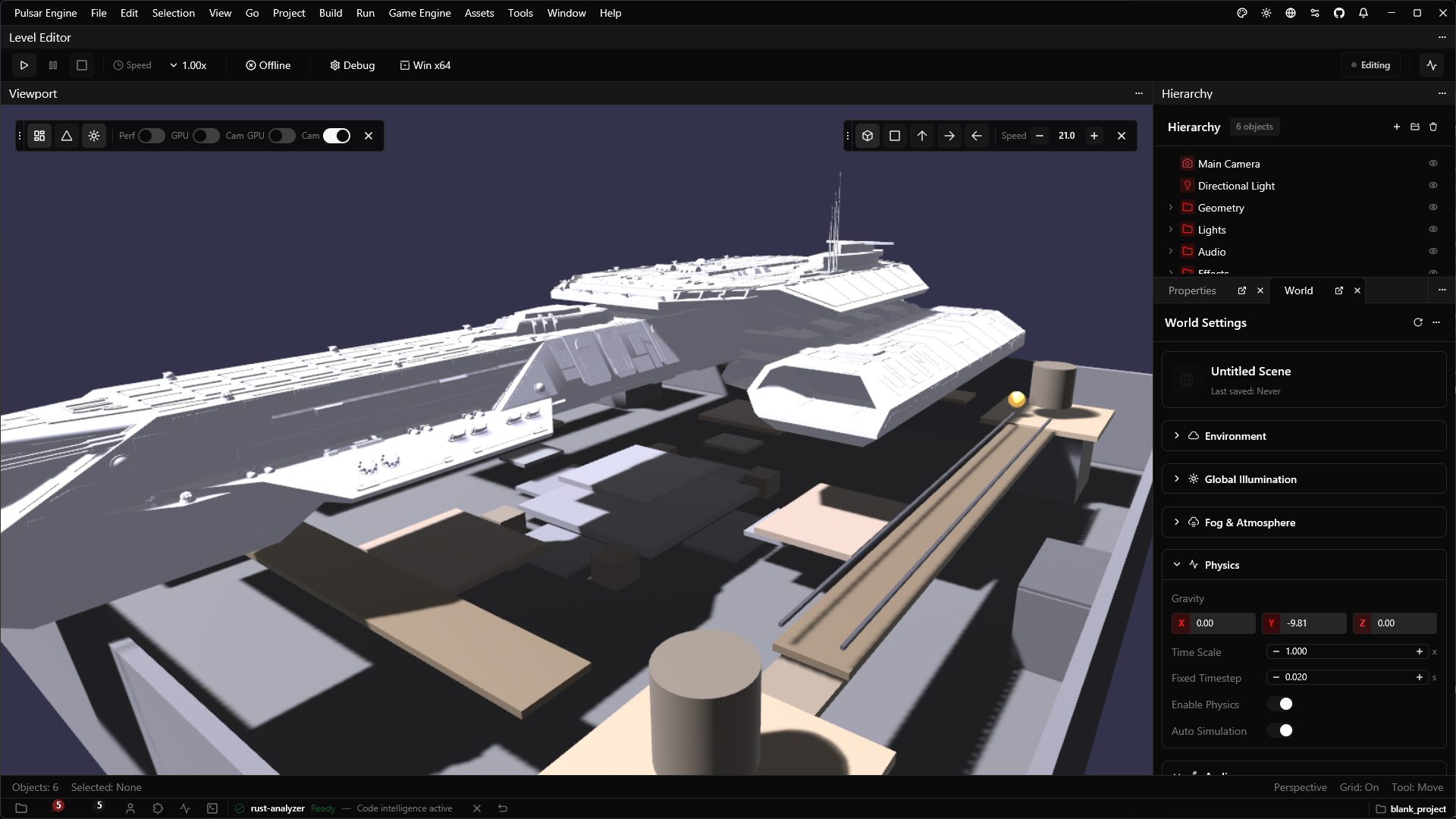
Visual Level Editor
Place entities, sculpt terrain, and wire up scene graphs in a GPU-accelerated GPUI interface. Assets are serialized to plain text — version-controllable with Git, diffable, and human-readable.
- Real-time 3D viewport via Bevy
- File drawer for asset navigation
- Text-based asset format
Performance
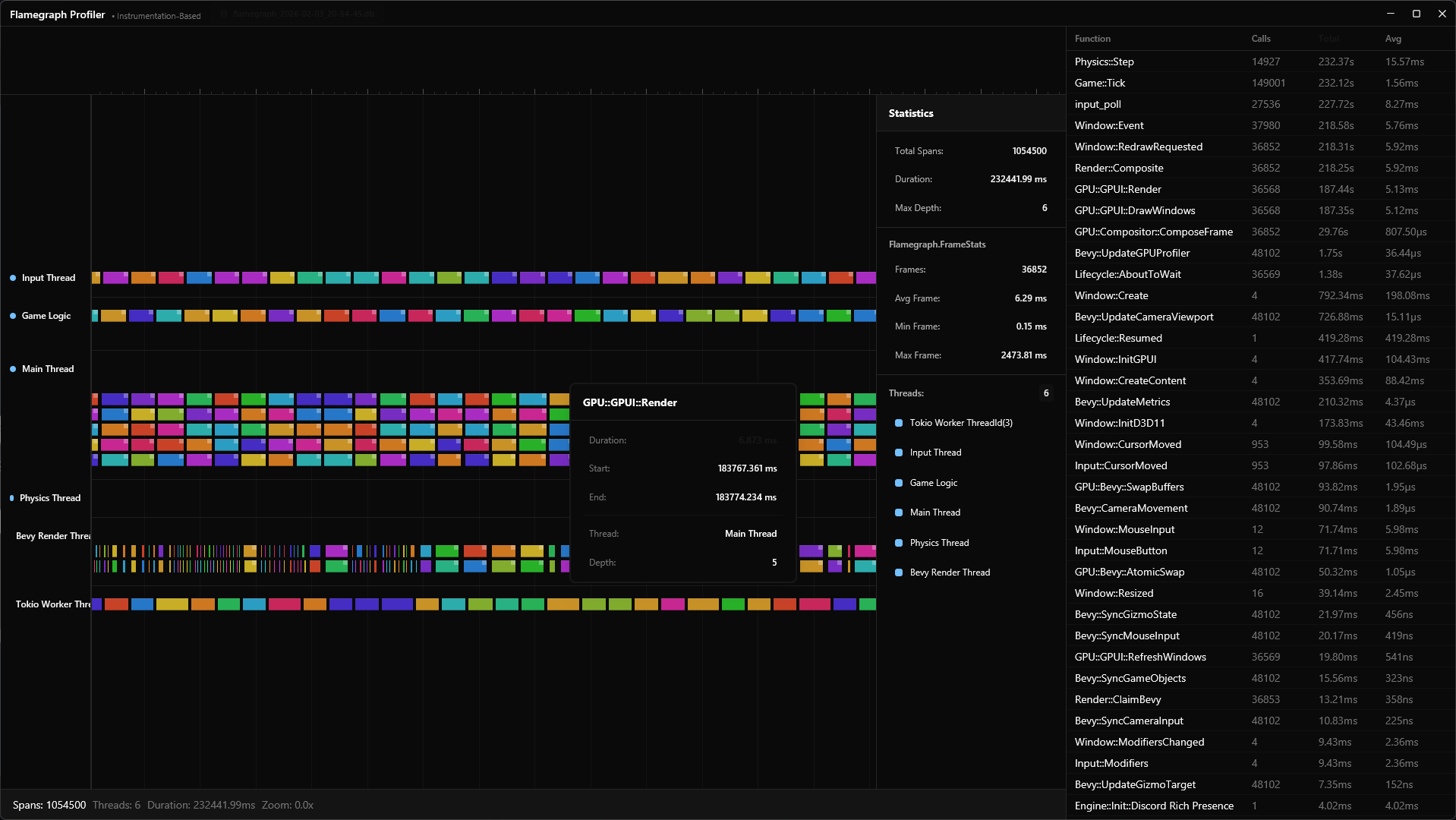
Tracy Profiler Integration
Nanosecond-precision instrumentation is embedded throughout the engine. See per-thread flame graphs, frame timings, and initialization bottlenecks without leaving the editor.
- Nanosecond-precision tracing
- Per-thread flame graphs
- Engine-wide instrumentation
Type Intelligence
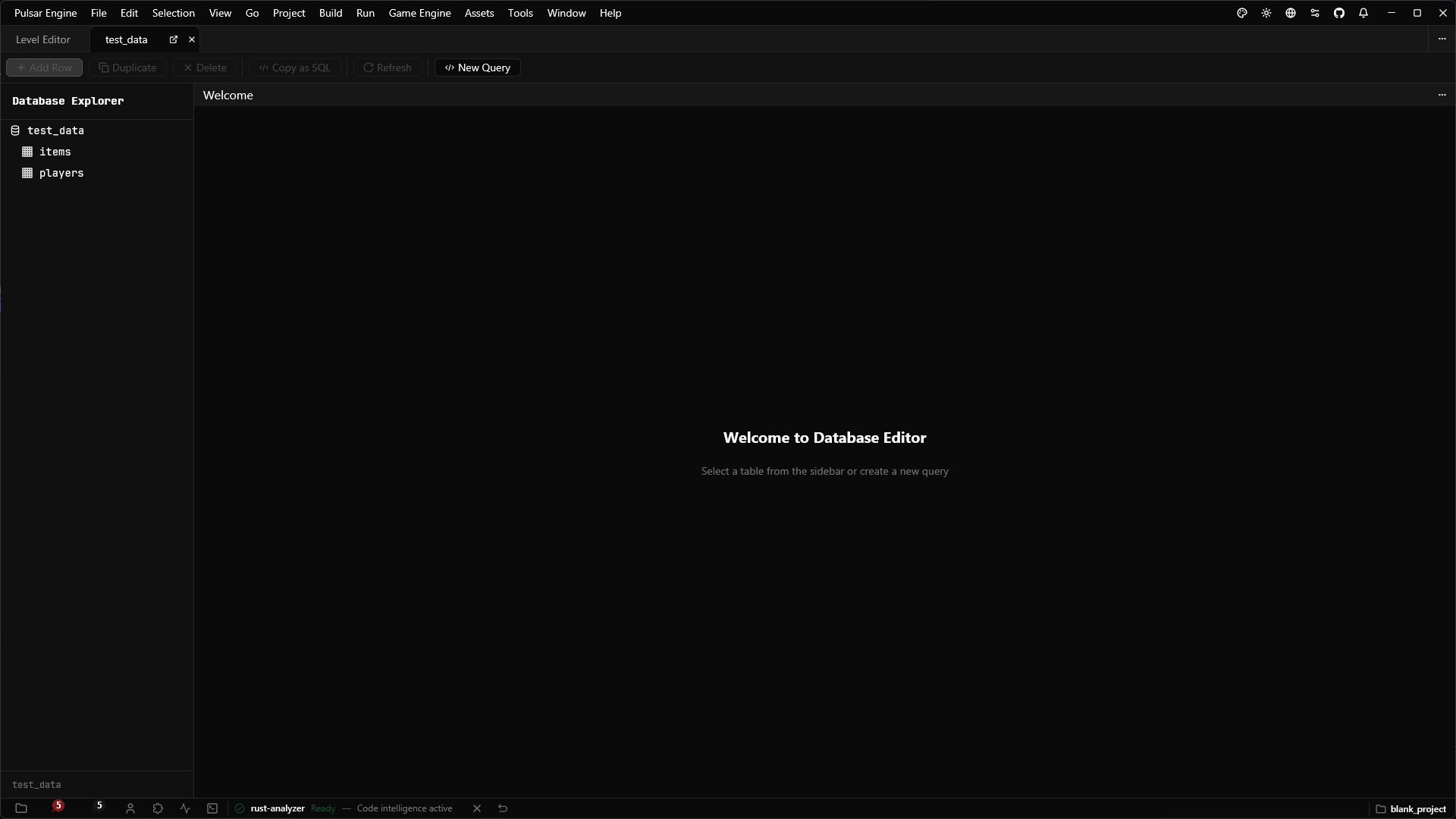
Type Database & Debugger
Pulsar maintains a live type registry of your project — every struct, enum, trait, and alias. The Type Debugger UI panel lets you browse, search, and inspect types in real time.
- Live type registry
- Struct/enum/trait inspection
- Powered by Rust Analyzer
Integrated Tooling
Built-in Terminal & Code Editor
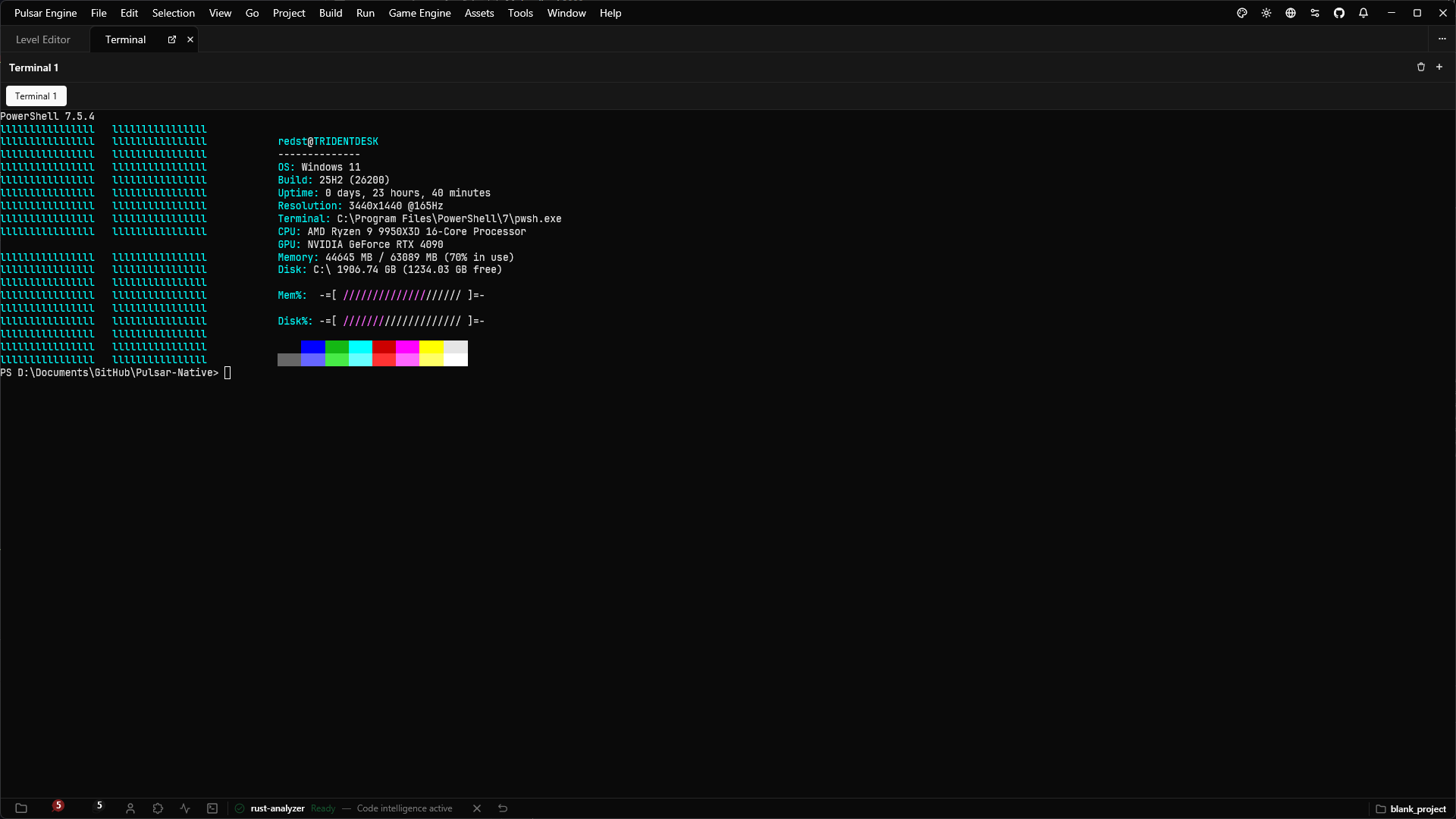
Run Cargo builds, fire off scripts, and inspect engine logs without switching windows. The integrated code editor provides full Rust Analyzer support — completions, diagnostics, go-to-definition.
- Full shell access
- Rust Analyzer LSP integration
- Live diagnostics panel
Code First
Real Engine Code
Everything here is from the actual Pulsar codebase — not mock-ups.
1use pulsar_std::prelude::*;
2
3pub fn main() {
4    env_logger::init();
5
6    let mut app = PulsarApp::new();
7
8    // Register your project's types
9    app.register_type::<GameState>();
10    app.register_type::<Inventory>();
11    app.register_type::<PlayerData>();
12
13    // Register game systems
14    app.add_system(game_state_system);
15    app.add_system(inventory_system);
16    app.add_system(player_update_system);
17
18    // Load the default scene and run
19    app.load_scene("scenes/default.level");
20    app.run();
21}
Initialize Pulsar, register types, load a scene, and run.
Capabilities
Everything in One Engine
No plugins required for the essentials. It's all there.
Simple and debuggable
GameObject Architecture
Pulsar uses straightforward GameObject structs with position, velocity, rotation, and scale — not ECS. The GameThread updates them at a fixed 60 TPS. Easy to understand, easy to debug.
Getting Started
Up in Four Commands
No project config maze. No XML. No build scripts you didn't write.
Install Rust
Requires Rust stable toolchain and Visual Studio C++ build tools on Windows
Clone the repository
Or download a binary from the Releases page on GitHub
Build the engine
First build compiles all dependencies — subsequent builds are much faster
Run it
The Pulsar launcher will open — create a project from the Templates tab
Community
What's Happening
Follow along as Pulsar grows — releases, discussions, and contributions.
Recent Announcements
View all →Loading announcements...
Connect with the community and share your projects on GitHub Discussions.
We welcome contributions — check out open issues and repositories.
The Mac and Linux platforms currently do not build on the main branch this is due to some changes made to our fork of GPUI to better support high perf...

tristanpoland
Add any patch ideas you have below in comments Far-Beyond-Pulsar/WGPUI#5
tristanpoland
Helio This is still very much a WIP but we made wonderful progress the last couple days and have a full 3D scene with basic lighting, materials, and a...
tristanpoland
Idea: Running walkers OR galileo (both are world/tile map renderers targeting wgpu) and gpui (via WGPUI) together. Maybe very similar to what Pulsar-N...

sectore
Hello All! I am currently working deep in GPUI to add Bring-Your-Own-Window support. This will allow us to establish a Winit window and render the 3D ...
tristanpoland